
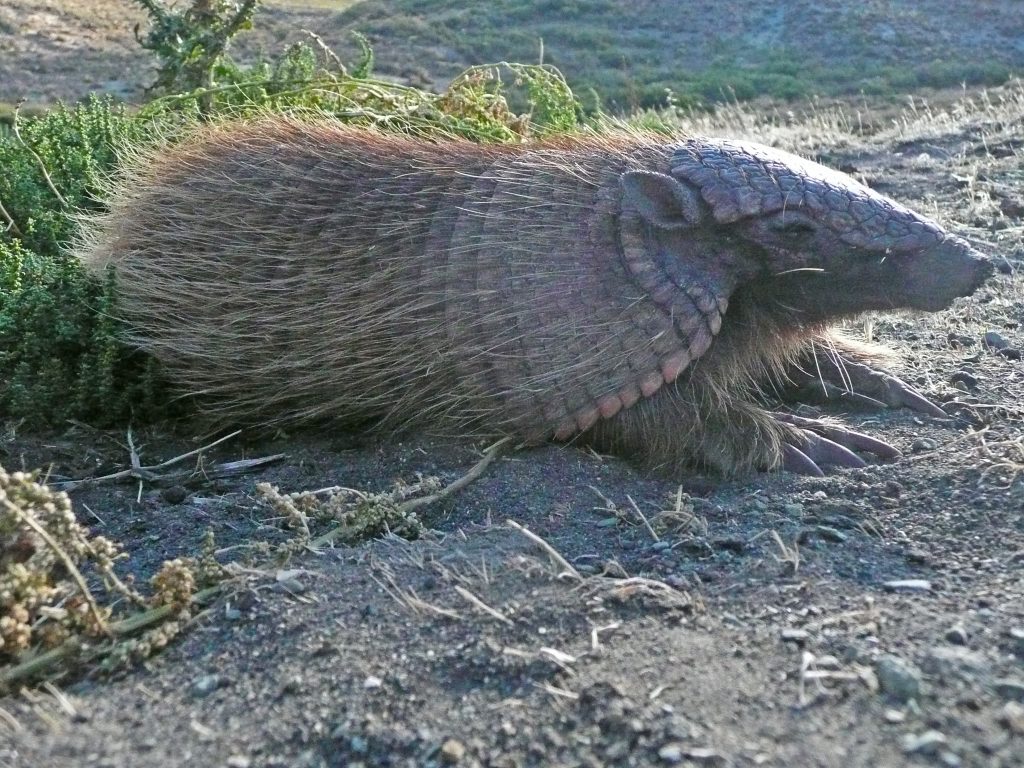
Okay viewers, gather round. You did all that work, went out into the Matrix, stretched your consciousness across space and time… and the universe responded with: the screaming hairy armadillo. Yes. That is a real animal. And yes, it does exactly what it says on the label.
What many of you probably picked up:
A small, low-to-the-ground, compact shape. A few of you likely got “football, ” “potato, ” or “rock with legs.” Often with muted tan, brown, or gray tones, maybe even a “dusty beige” feel. Hard, segmented exterior with softer stuff underneath. Think: armor plates, but with fuzzy hair sticking out. You might have perceived the armor as light brown, yellowish-brown, or sand-colored, with the hair coming through as pale, whitish, or straw-colored. Dry, dusty, open environment., Sandy or dusty soil in light tan, ochre, or grayish-brown, scrubby plants with dull green or olive impressions, maybe “grassland, ” “steppe, ” “semi-desert, ” or just “hot, flat, dusty ground” colors., Burrow, tunnel, or “small cave” energy.,
Many of you probably felt something going underground: a tube, a burrow, or a snug hollow space in brown, dark tan, or shadowy gray tones. Bonus points if you sensed more than one entrance or the idea of an opening being blocked or “plugged.” Time-of-day weirdness. Some of you may have felt “nighttime” activity with darker blues, indigos, and muted tones, others “daytime” with bright yellow-white sunlight and high contrast. This little being actually switches it up by season, so if your data conflicted, you still may have been right.
Strange, high-pitched sound., If you had fleeting impressions of squealing, squeaking, “tiny scream, ” or “sharp cry, ” that’s the target literally announcing itself. You might have paired that sound with quick flashes of white, bright yellow, or “sharp” colors in your internal imagery.
How your data maps to the target:
Descriptors like “small mammal, ” “rodent-like, ” “hedgehog-like, ” “armored animal, ” or even “turtle but wrong” are all in the zone, especially paired with tan/brown body colors. Anything about “plates, ” “shell, ” “bands, ” or “segmented armor” links nicely to the armadillo carapace, typically perceived as light brown, beige, or dusty yellow-brown. Notes such as “fur, ” “hair, ” “bristly, ” or “fuzzy texture on top of something hard” are exactly what this species looks like, often with impressions of pale, cream, or straw-colored hair. Environmental data such as “hot, ” “dry, ” “windy, ” “dusty plains, ” “scrub, ” or “short grasses” all fit its native habitat, usually showing up in viewer data as tan, light brown, olive green, dull green, and faded yellow. Movement descriptors like “low scuttling, ” “digging, ” “scratching, ” “burrowing, ” or “staying close to the ground” also track very well, sometimes with flashes of dark brown or shadowy gray as it moves in and out of the burrow.
Session moments I’d expect to see in your transcripts:
The sketch that looks like a football wearing chainmail and a wig, colored in tan or light brown with some lighter cream or whitish scribbles for hair. The person who insisted, “It feels like a small animal, but I keep wanting to say ‘armor’ or ‘shell’ and I don’t know why, ” while noting brown, beige, or “earth tones.”Whoever wrote, “Hearing a weird little scream or squeak, might be symbolic?” That’s not symbolic. That’s just your target—and you may have also gotten a sudden flash of bright white or yellow in your internal visual field as the sound hit. Someone probably argued with themselves: “Reptile? Mammal? Reptile? Mammal?” Welcome to armadillos: mammals doing a turtle cosplay in a very sand-colored outfit. For scoring and feedback, , Look for these kinds of hits:, , Size: “small, ” “hand-sized, ” “football-sized, ” “less than a dog.”, , Structure: “shell, ” “armor, ” “plates, ” “bands, ” “hard exterior, soft interior.”, , Texture: “rough, ” “bumpy, ” “scaly, ” and “hairy, ” “bristly, ” “coarse fur.”
Colors (target and environment): Body/armor: tan, light brown, beige, yellowish-brown, “dusty neutral.”, , Hair: pale, off-white, cream, straw-colored. Environment: tan or light brown soil, dull green/olive shrubs, faded yellow grasses, blue/white sky or darker blue/indigo tones for nighttime. Environment: “semi-arid, ” “dry, ” “grassy, ” “dusty plains, ” “shrubs, ” “farmland/fields.” Function/behavior: “digging, ” “burrow, ” “tunnel, ” “underground, ” “nocturnal/crepuscular, ” “skittish, ” “defensive.” Audio: “squeal, ” “screech, ” “sharp cry, ” “tiny scream, ” or just “startling high sound.” If you got a combination like “small animal + tan/brown armor + pale hair + digging + dry tan ground, ” that’s excellent target contact. If you literally drew a screaming beige potato with little cream hairs and legs, you are now promoted to Honorary Armadillo Color Analyst.
In Closing, So yes, your noble mission target was not a secret base or an ancient temple, but a tiny, screaming, hairy, armored chaos-bean in tan and cream tones from the South American drylands. Next time you find yourself describing “small, armored, furry, loud, earth-toned, and slightly ridiculous, ” you’ll know: you might be back with the screaming hairy armadillo.
To ensure your submission is processed quickly, please merge your photos or documents into a single PDF file before uploading. Here are the easiest ways to do it:
If you already have multiple PDF files on your computer: